

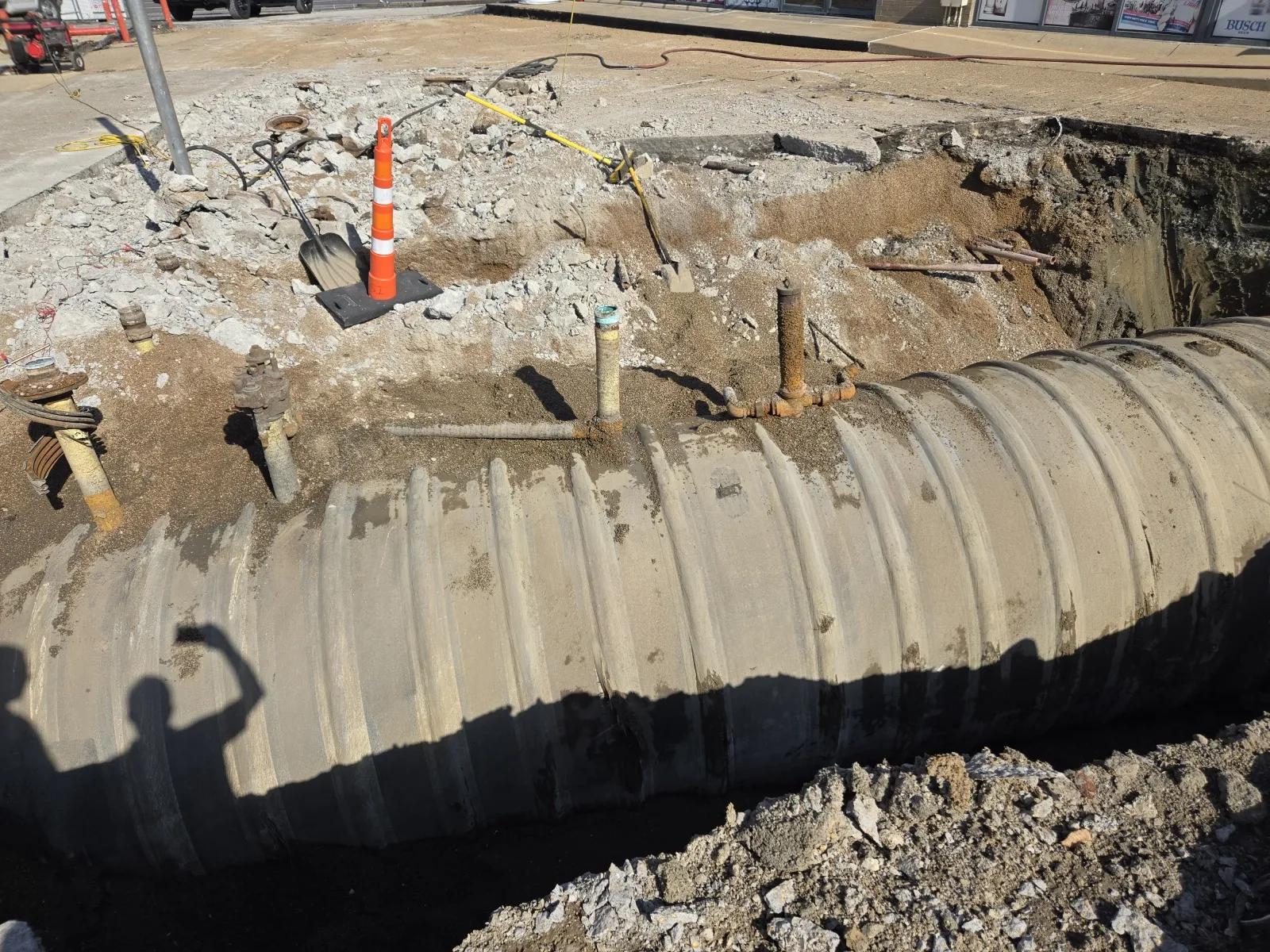

How much does oil tank removal cost?
Angi reports that oil tank removal averages $1,357 nationally, based on 266 verified projects from Angi Pros. Most homeowners pay $593 to $2,153, depending on tank type, size and location. Those figures cover the removal itself. Soil testing, cleanup and yard repair are extra.
AES quotes each job; call (314) 865-2662 or use /contact.
Angi also splits the price by tank type and size. Here is what its tables report.
| Tank | Angi’s reported average cost |
|---|---|
| Aboveground | $400 to $1,000 |
| Underground | $1,500 to $3,000 |
| Specialty (built into a basement or reinforced with concrete) | $2,000 to $7,000 |
| 275-gallon tank | $800 to $1,200 |
| 500-gallon tank | $1,200 to $1,800 |
| 1,000-gallon tank | $1,300 to $2,000 or more |
Angi’s size and type tables overlap, so read them as two views of the same market, not as a menu you can add together.
Regional contractors land in the same area. Curren Environmental, a New Jersey firm, says the typical cost to remove a heating oil underground tank, including labor and soil sampling, is $1,600 to $2,000. Those are New Jersey and national figures. No source we opened gives a St. Louis price.
Why does the price swing so much?
Four things set most of the spread. The first is whether the tank sits above or below ground. Angi says underground tanks require digging, soil testing and carry added environmental risks, which raise labor and disposal fees. An aboveground tank needs no excavation.
The second is access. A tank in a basement, under a deck or beside a tight lot line takes more labor than one in an open yard. Angi says tanks under decks, driveways or in tight spaces will raise labor costs.
The third is what is left in the tank, since draining remaining oil takes time. The fourth is local rules and permits. Angi lists site prep at $200 to $1,000, which covers clearing access, disconnecting fuel lines, draining remaining oil and obtaining required permits.
Angi also says labor typically runs $50 to $150 per hour on larger or more complex jobs, while smaller removals are often a flat fee. Curren Environmental names the amount of liquid present, permit fees and access to the tank as the factors that adjust its price.
What costs come after the tank is out?
Cleanup can cost more than the removal if the ground is stained. Angi reports these add-ons:
- Soil testing: $100 to $300 per test, if contamination is found during removal. Angi’s add-on list gives a different view: $50 to $200 per sample, or $300 to $1,000 per project.
- Backfilling and grading: $5 to $15 per square foot, depending on material and site conditions.
- Soil remediation: $50 to $200 per cubic yard, or $1,000 to $10,000 per project, depending on contamination.
- Landscaping restoration: $500 to $3,000 for sod, seeding or plant replacement.
Those are Angi’s national numbers. Cleanup depends entirely on what the soil tests show. A clean tank pit may need only backfill. A leak may need soil remediation and a plan for disposal. AES offers soil remediation and says that if a tank has leaked or contaminated the surrounding soil or groundwater, its team provides remediation and cleaning services.
Does Missouri regulate a home heating oil tank?
Federal tank rules do not cover it, and Missouri DNR does not regulate aboveground tank operation, but your city or county may. EPA says tanks that store heating oil for use on the same premises are excluded from federal underground storage tank rules. EPA adds that state or local agencies may still regulate them.
Missouri DNR says it does not regulate the operation of aboveground storage tanks. It points owners to the Missouri Department of Agriculture for that.
That does not mean a leak is someone else’s problem. A release into soil or groundwater still creates a cleanup duty and a risk for the property. Angi says you may need to provide proof of removal to your insurance company.
Not sure the tank has to come out at all? Our post on whether an old oil tank has to be removed covers that question. For regulated commercial and industrial tanks, Missouri DNR closure rules apply. See our tank removal and closure guide for that side. For permits on a home tank, call your city or county building office before work starts. The right office differs by address.
What does AES do on an oil tank job?
AES describes its oil tank removal this way:
- A site survey and assessment before removal, to identify potential contamination and check that regulatory requirements are met.
- A customized removal plan.
- Permits, then excavation around the tank for underground tanks, draining remaining oil, and removal.
- Transport of the tank to a certified disposal facility. See hazardous waste for how waste is classed.
- Remediation, if the tank leaked into the soil or groundwater.
The AES oil tank removal page covers homes, commercial properties, industrial sites and public buildings. For larger industrial and underground systems, see underground storage tank removal and tank removal. If you only need the tank hauled, read about fuel tank disposal.
Which costs apply to my tank?
Match your situation to the table, then ask each bidder which lines they include.
| Your situation | Cost lines to expect | Angi’s reported figure |
|---|---|---|
| Aboveground tank, clear access | Removal, draining, disposal | $400 to $1,000 for removal |
| Underground tank | Excavation, soil testing, removal | $1,500 to $3,000 for removal |
| Tank built into a basement or reinforced with concrete | Extra steps and labor | $2,000 to $7,000 for removal |
| Lines, vents or monitoring wells to pull | Added work | $200 to $800 |
| Oil left in the tank | Haul and dispose of residual oil | $2 to $5 per gallon, or a flat fee of $100 to $500 |
| Permits | Municipal fees | $50 to $500, depending on your municipality |
| Leak found | Testing and soil cleanup | $100 to $300 per soil test; $1,000 to $10,000 per project for remediation, depending on contamination |
Angi also gives sizes, so a 275-gallon basement tank and a 1,000-gallon buried tank are not the same bid. Ask the contractor to write the tank size and location on the quote.
What should I do if I think a buried tank is on my property?
Do not dig it up yourself. Look for a fill pipe or vent pipe near the foundation, a patch in the basement wall where a line enters or an old oil furnace. Then ask for a site assessment before any digging.
A site assessment is what AES describes first on its oil tank page: a survey that identifies potential contamination, helps set the removal strategy and checks regulatory requirements. If the tank turns out to be a larger or regulated system, the tank removal and closure guide explains the Missouri DNR steps.
Should I remove the tank myself to save money?
No. Angi says that while you can save on labor, you risk fines, environmental hazards and improper removal if you lack experience. A tank can hold leftover oil, and a spill can reach the soil.
The money you save on labor is small next to one soil cleanup. Hire a contractor who handles removal, disposal and soil sampling as one plan.
How do I get a good oil tank quote?
Ask for a written quote, then check these points before you sign. Bender’s Oil Service, a Connecticut contractor, makes the same point: a cheaper quote is not useful if one contractor included pump-out, disposal, backfill and permits while another only priced the physical removal.
- Is the tank aboveground, underground or in the basement, and what size is it?
- Does the price include draining, cutting, hauling and disposal?
- Who pulls permits?
- Does the price include soil sampling, and what happens if the sample comes back dirty?
- Is backfill, grading or yard repair included?
- Will you get paperwork showing the tank was removed and where it went?
Take photos of the tank and the fill pipe before the visit. Say if the house has a buried vent or fill line. Those details change the plan.
Next step
Call AES at (314) 865-2662 or use /contact to describe your tank. AES quotes each job, and offers a site assessment and survey before removal so the plan matches what is in the ground.
Frequently asked questions
How much does it cost to remove an oil tank?
Angi reports a national average of $1,357, with most homeowners paying $593 to $2,153. Its table puts aboveground tanks at $400 to $1,000 and underground tanks at $1,500 to $3,000. Soil testing and cleanup are extra. AES quotes each job; call (314) 865-2662 or use /contact.
Why does an underground oil tank cost more to remove?
Angi says underground tanks require digging and soil testing and carry added environmental risks, which raise both labor and disposal fees. An aboveground tank needs no excavation, so Angi calls it the more affordable option.
What if the tank has leaked?
Cleanup is a separate cost. Angi budgets $100 to $300 per soil test if contamination is found, and reports soil remediation at $50 to $200 per cubic yard or $1,000 to $10,000 per project, depending on contamination. A site survey shows what is in the ground before removal.
Does Missouri regulate a home heating oil tank?
EPA says heating oil tanks used for consumption on the premises are excluded from federal UST rules, but state or local agencies may regulate them. Missouri DNR says it does not regulate the operation of aboveground tanks. Ask your city or county about permits before work starts.
Can I remove an old oil tank myself?
It is risky. Angi says DIY removal risks fines, environmental hazards and improper removal if you lack experience. A tank can hold leftover oil and sludge, and a leak can reach soil. A contractor drains the tank, removes it and hauls it to an authorized facility.
Terms on this page
Sources
- Angi: How Much Does Oil Tank Removal Cost? [2026 Data]
- Angi: How Much Does Oil Tank Removal Cost? (verified projects)
- Angi: How Much Does Oil Tank Removal Cost? (soil test)
- Angi: How Much Does Oil Tank Removal Cost? (underground)
- Angi: How Much Does Oil Tank Removal Cost? (sizes)
- Angi: How Much Does Oil Tank Removal Cost? (prep)
- Angi: How Much Does Oil Tank Removal Cost? (DIY)
- Angi: How Much Does Oil Tank Removal Cost? (remediation)
- Angi: How Much Does Oil Tank Removal Cost? (restoration)
- Angi: How Much Does Oil Tank Removal Cost? (access)
- Angi: How Much Does Oil Tank Removal Cost? (insurance)
- US EPA: Frequent Questions About Underground Storage Tanks
- Missouri DNR: Underground Storage Tank Requirements
- Angi: How Much Does Oil Tank Removal Cost? (permits)
- Angi: How Much Does Oil Tank Removal Cost? (residual oil)
- Angi: How Much Does Oil Tank Removal Cost? (lines and wells)
- Angi: How Much Does Oil Tank Removal Cost? (labor)
- Angi: How Much Does Oil Tank Removal Cost? (backfill)
- Angi: How Much Does Oil Tank Removal Cost? (soil sample)
- Curren Environmental: How Much Does an Oil Tank Removal Cost in New Jersey?
- Bender's Oil Service: Oil Tank Removal Cost in CT
Written by Advanced Environmental Services and checked against the sources above on October 19, 2026. Rules change, so check the linked page before you act.